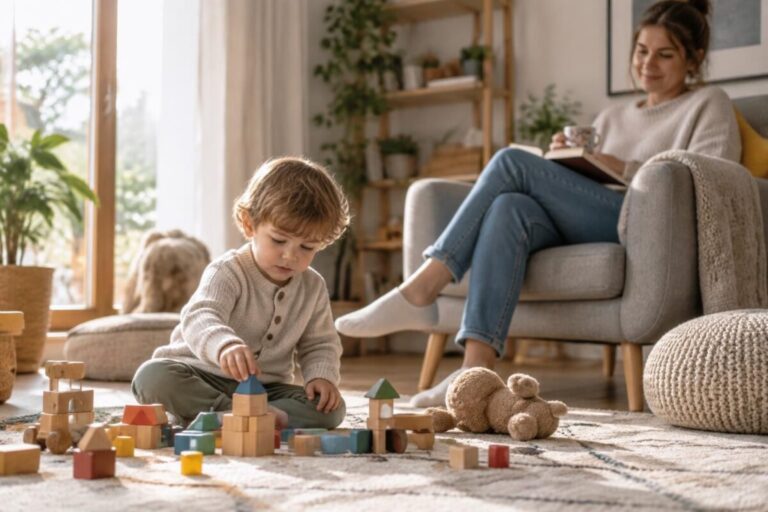

Parenting: should you repeat yourself or take action right away?
Hi, this is Manon. Repeating yourself can help in the moment, but to get things done without wearing yourself out, it’s better to give a clear instruction, prepare for the transition, and leave a visible cue. When a child doesn’t respond right away, it doesn’t necessarily mean they’re refusing or being disobedient. Simple routines help them know what to do without turning a parent into the household loudspeaker.
Things to do now
- Choose one instruction that comes up often, such as “go put on your pajamas.”
- Give it calmly, close to your child, using simple words.
- Give them a few minutes’ warning before an important transition.
- Display the steps to follow using words, drawings, or pictograms.
- After making your request, wait a little before repeating it.
In the evening, requests can easily pile up: pajamas, teeth, bag, tidying up. To cut down on the repetition, start with one step and make it easy to find. You can also read these tips on how to stop repeating the same instructions and this reflection on communicating with your child without wearing yourself out.
Why repeating yourself doesn’t always get things moving
A child may be absorbed in play, tired, or simply find it difficult to switch to another activity in the moment. Following an instruction can sometimes mean stopping, keeping the information in mind, and starting a new task.
When the same request is repeated several times without anything changing, a child may learn to wait for the next reminder. It isn’t necessarily intentional: the first request can start to seem less urgent. So the goal isn’t to shout louder, but to make the request easier to understand and the move to action more predictable.
In a family, bedtime can feel like a loop: “Put on your pajamas,” then “Did you hear me?” With an illustrated list placed near the bathroom, a child can find the steps without waiting for each reminder. A visible cue supports independence without requiring instant obedience.
Two situations, two responses
If your child is absorbed in an activity, announce the transition and give them a realistic amount of time before moving on to the next step. If they don’t understand the instruction or it seems too long, simplify it and give them one action at a time.
“One clear instruction is better than three rushed reminders.” This doesn’t mean you should give up on setting limits: it encourages you to pair discipline with consistent cues, rather than repeating yourself endlessly.
Repeat yourself or get things moving: choose the right approach
Getting things moving right away doesn’t mean rushing your child or expecting an immediate response in every situation. It means saying what you expect, checking that your child understood, and then helping them take the first step if needed.
| Situation | Helpful response | Avoid |
|---|---|---|
| Your child is playing and bath time is approaching | Give a warning, then clearly indicate when it’s time to transition | Interrupting without warning and repeating yourself right away |
| The instruction involves several actions | Break it down into simple steps | Giving a long list to remember |
| Your child seems not to hear you | Move closer, get their attention, and rephrase | Speaking louder from another room |
| The bedtime routine happens every day | Display the steps in a consistent order | Keeping everything in the parent’s memory |
A list doesn’t need to be perfect to help. It can include just a few steps, be suited to your child’s age, and change as the routine changes. Consistency matters more than perfection.
A three-step method for replacing reminders with cues
Step 1: choose a repeated instruction. Identify the one that comes up most often during the day. It’s better to start with “pack your bag” or “put on your pajamas” than to try to reorganize the whole house at once.
Step 2: turn it into a concrete cue. Display a checklist, a drawing, or a simple routine where the action takes place. For a young child, pictures may be enough; an older child can follow a written list.
Step 3: give a warning, then allow time to act. Give notice before the transition, make a brief request, and wait a few moments. If your child doesn’t get started, move closer and help them identify the first action instead of piling on reminders.
For example, a bedtime routine could display three steps: pajamas, teeth, reading. After a few days, your child may start checking the chart on their own; if not, adjust the visual aid and calmly continue the routine.
At first, progress is often modest: one fewer reminder, one step completed without help, a slightly calmer evening. Learning to take responsibility happens gradually, through clear expectations and opportunities to practice.
Clearer instructions, calmer communication
Repeating yourself once can be helpful, especially with a young child or during a hectic moment. But if every step depends on the parent’s voice, daily life becomes tiring for everyone. Visual cues, announced transitions, and a consistent routine make taking action right away more achievable, without confusing parenting with constant control.
A simple everyday example shows how it works: a child who ignored the call to brush their teeth every evening started checking the pictures posted near the sink. The change wasn’t magical, but the parent was able to replace several reminders with a simple “What’s the next step?”
If your child doesn’t follow through, first check whether they heard and understood the request, and whether the timing was right. A system that helps is better than a voice that keeps insisting: less tension leaves more room for connection and cooperation.
Should you always repeat an instruction to a young child?
No, not every time. A reminder may be necessary, but a brief request, a visual cue, and a consistent routine help a child understand what to do without relying solely on the parent’s words.
How long should you wait before repeating yourself?
There is no universal timeframe. Give your child time to stop what they’re doing and process the request, then move closer and rephrase if needed.
Is a visual routine suitable for all ages?
It can be adapted for children from their early years using simple pictures. As a child gets older, pictograms can be replaced with a written checklist or a schedule.
What should I do if my child refuses despite clear instructions?
Maintain a calm limit and check what’s getting in the way: tiredness, a transition that’s too abrupt, an instruction that’s too long, or a difficult step. Help them get started if needed, then adjust the cue rather than repeating yourself endlessly.
Thanks for reading! Feel free to share your observations in the comments. — Manon