
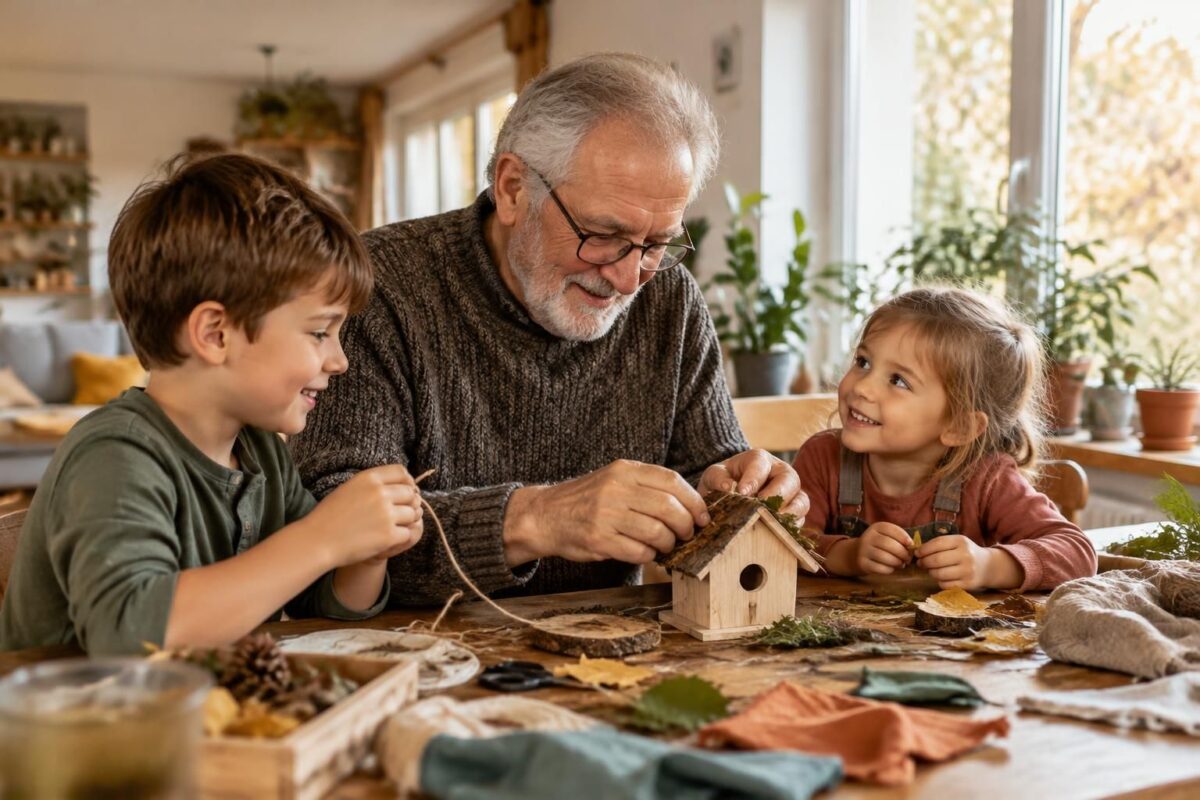
Transmission: hands-on activity for children and genuine values
Hi, it’s Manon here. A simple craft activity can teach real values: create a useful or meaningful object with your child, then let them choose, try things out and help tidy up. With some paper, a little glue and a few upcycled materials, sharing becomes a hands-on learning experience. What matters most isn’t the result, but the time spent making something together.
Things to do now
- Choose a value to share: helping one another, patience, respect or gratitude.
- Gather a few simple materials: cardboard, paper, tubes or leaves.
- Suggest a short activity suited to your child’s age.
- Let them choose the colors and take part in whatever steps they can.
- Finish by admiring the creation and tidying up together.
A thank-you card, a little decorated pot or a mural made together is enough to make the moment meaningful. To explore the idea further, here are some thoughts on the connection created by making things together and on the values to hold on to every day.
A craft activity for passing on family values
A craft activity helps children understand a value because they experience it rather than simply hear about it. Getting the materials ready together encourages independence, waiting for a turn invites patience, and sharing tools makes helping one another visible.
For example, making a group garland lets everyone create a shape and then assemble it with the others. The finished piece simply shows that every contribution matters: a lovely way to talk about respect and sharing without a long speech.
One afternoon, a little girl wanted to glue all the leaves onto a family mural herself. Her brother suggested choosing the colors: in the end, they made the decision together, and their tree became a project they both shared.
“The things we do together become memories that stay with us.” This idea guides my article: prioritize connection and the skills passed on rather than a perfect craft project.
Simple ideas for different ages and values
Choose an accessible activity and leave room for your child’s ideas. Depending on their age and confidence, allow about 5 to 10 minutes for younger children, and 10 to 20 minutes for children who want to keep going.
| Activity | Value to share | What the child does |
|---|---|---|
| Thank-you card | Gratitude | Glue and decorate freely |
| Group mural | Cooperation | Add their shape or color |
| Decorated cardboard pot | Patience and care | Paint, glue, then tidy up |
| Paper puppets | Listening and imagination | Create a character and make up a story |
How to prepare a craft activity that encourages sharing
A simple setup leaves more room for creativity. Put the materials within easy reach, protect the table and give one instruction at a time: that way, your child can get involved without constantly waiting for an adult.
- Choose a value and an action : for example, practice helping one another by making a mural together.
- Keep the materials to a minimum : a few sheets of paper, crayons and glue are often enough.
- Create, share and tidy up : let everyone work at their own pace, then invite your child to help tidy up.
For little ones, choose pieces of paper that have already been cut or torn, chunky crayons and washable paint. Use child-safe scissors and keep small items under adult supervision.
If your child is very young, suggest one simple action, such as gluing large shapes. If your child is older, invite them to design part of the project and explain their choices.
Value the experience, not perfection
A craft project for passing on values doesn’t need to look like a model. When an adult corrects every detail, a child may think that only the finished appearance matters; when you welcome their attempts, you build their confidence and enjoyment of learning.
You can put what you notice into words: “You waited for your turn” or “You found a solution together.” These words connect the action to the value without turning the moment into a lesson. A successful craft activity leaves its mark on your hands, but also on your relationship.
To build on this idea, a demonstration of a family craft project can help you choose something easy to adapt to the child’s age and the materials available.
Practical questions about craft activities and values
Which craft activity should I choose to teach sharing?
A group mural, a card made together or puppets to invent as a group let every child contribute in their own way.
How can I adapt the activity for a young child?
Reduce the number of steps and suggest one action at a time, such as gluing, stamping or painting with an easy-to-grip tool. Stay nearby to keep them safe.
Should I correct my child’s creation?
Avoid trying to make it perfect for them. Encourage their attempts and point out the patience, helpfulness or independence you have noticed.
What materials can I use for low-cost crafts?
Cardboard, tubes, scraps of paper and a few crayons are enough for many projects. Reuse clean materials that are suitable for your child’s age.
Thanks for your curiosity; Manon

