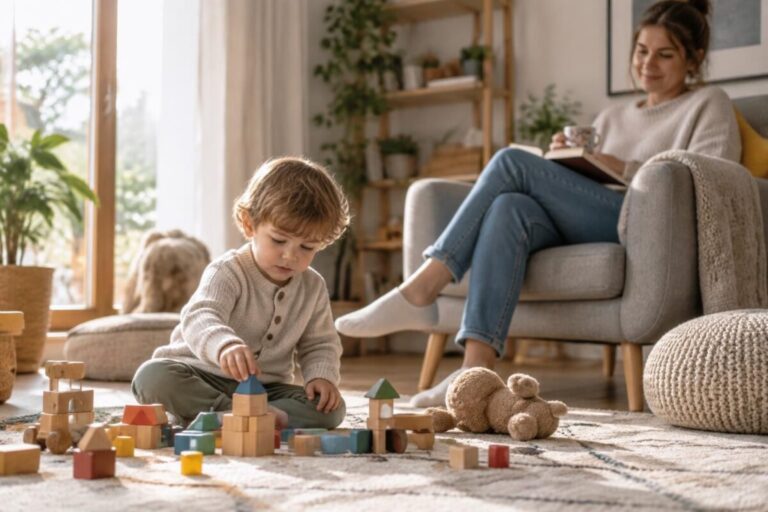

Couple life: Does your child see your values before your words?
Hello, it’s Manon. Yes, children often observe your values in your actions before they understand them in your words. They see how you speak to each other, set boundaries, and resolve disagreements. In your relationship, being a role model as parents matters just as much as the rules you lay down.
What you can do right now
- Choose two or three family values you want to put into practice every day.
- Talk with your partner about the rules that protect everyone’s respect and safety.
- Lead by example: listen, apologize, and follow through on your commitments.
- Avoid contradicting the other adult in front of your child; continue the discussion in private.
- Focus on repeated actions rather than expecting perfect consistency every day.
Disagreements don’t necessarily mean that you and your partner are incompatible. But if your words promise one rule while your behavior keeps undermining it, your child may receive confusing signals; taking stock of your parenting values can help you distinguish fundamental differences from negotiable habits, as can thinking about how to set a boundary your child can understand.
What children learn by observing your relationship
Raising children isn’t just about giving instructions. Parents’ behavior shows them how to treat others, share decisions, and work through tension without humiliating or threatening anyone.
One evening, Camille and her partner argued about bedtime in front of the children. They continued the discussion afterward, then explained the agreed-upon rule together. This brief return to calm showed that a disagreement can be resolved without either adult losing their place.
“Children hear our words, but above all, they watch what we do with them.” This idea sums up the role of parents as role models: children notice the gap between the values adults talk about and the actions they repeat. Values are passed on more effectively when adults also model mutual respect.
Actions that make your values visible
| Family value | Concrete action | What your child learns |
|---|---|---|
| Respect | Listen without making fun of others and greet the people who are there. | Everyone deserves basic consideration. |
| Responsibility | Admit a mistake and make amends for its effects. | You can take responsibility for your actions without losing your dignity. |
| Solidarity | Share a task instead of leaving one adult to do everything. | Family life depends on cooperation. |
| Dialogue | Express a disagreement without shouting or putting anyone down. | Differences can be discussed. |
When your values and parenting rules differ
You don’t need to agree on every detail to create consistency in how you raise your child. Difficulties tend to arise when disagreements involve safety, respect, or everyone’s place in the family and are left undiscussed.
In a blended family, this question also calls for taking the children’s history into account. A new partner can contribute to everyday life, but their authority develops gradually, with the parent’s agreement and clearly stated rules. Trying to take the other parent’s place or impose a new approach to parenting on your own can fuel tensions.
If your differences are about minor habits, decide what really matters and be flexible about the rest. If they concern respect, safety, or your plans for your life together, set aside a calm moment to see whether you can reach a concrete agreement.
A three-step approach to moving forward together
- Step 1: Name the need. Describe a specific event and how it affected you, without labeling the child or blaming your partner.
- Step 2: Choose a shared rule. Decide together what is expected, how you’ll remind your child, and what will happen if they forget.
- Step 3: Check in. After a few weeks, see whether the adults are following the rule and the child understands it; adjust it if necessary.
Communication as a couple doesn’t mean erasing your differences. It helps make them clear and allows you to decide together which ones can coexist. A simple rule that the adults consistently follow is often better than a long list that gets posted and then forgotten.
See your values in action in everyday moments
Everyday routines offer small opportunities to pass on values: sharing chores, saying you’re sorry, acknowledging an emotion, or respecting someone’s need for rest. Children don’t need a perfect couple; they need adults who can recognize when they’ve fallen short and return to their guiding principles.
If a discussion regularly turns into an argument, it’s best not to continue it in front of the children. A family mediator or other professional can help clarify everyone’s needs, especially when attempts to talk things through are no longer working.
Frequently asked questions about couples’ values and children
Do children always imitate their parents’ behavior?
Not always, and not automatically. But repeated actions give them cues about how to communicate, manage conflict, and treat others.
Do you have to agree on all parenting rules?
No. The important thing is to agree on the rules that matter for safety, respect, and living together, while remaining flexible about the details.
How should you react if a disagreement breaks out in front of your child?
Avoid putting each other down or contradicting each other at length in the moment. Continue the discussion in private, then present your child with a clear, consistent rule.
When should you seek outside help?
If the same arguments keep recurring without resolution or have a lasting effect on the family atmosphere, a family mediator or other professional can help facilitate dialogue.
Thanks for reading! Feel free to share your observations in the comments. — Manon